
As I mentioned in my review of the Nikon Z f, one of the drawbacks to me for this otherwise great camera is weight, the body alone tips the scales at 700g, add anything more than either of the small Z mount 28mm or 40mm prime lenses, and you soon learn possibly the biggest drawback to full-frame; a big sensor means heavy glass. After using the Z f for a while now, and despite buying two add-on grips, I’m also still not totally enamoured with the general ergonomics either. Yes, the retro styling looks great and I love some of the features, plus using dials for ISO, shutter speed and exposure compensation is second nature, but the complete package still somehow feels awkward compared to the Z5.
It’s largely the weight problem that’s been playing on my mind recently, as the opportunity has arisen to be able to acquire one, if not a pair of additional lenses. This is mainly to have next year to get used to any peculiarities they might posses, as well as how they handle on the Z f, ready for a much anticipated cruise to Hawaii from San Francisco in 2027. With the Z f, and standard Nikon 24-70 zoom I already have, plus definitely a wide angle zoom and maybe a telephoto zoom, I was considering buying, I’d have lost just over 1/4 of my cabin baggage allowance! Unsurprisingly then, I’ve been poring over my options.
Having already dabbled with Nikon’s DX range in the shape of the Z fc and commented on the limited options lens wise, I’d immediately ruled them out. After spending over ten years using Micro Four Thirds, and despite some new models arriving from OM Systems which have been very well reviewed, it doesn’t take you long to realise that, certainly in terms of sensor development, progress has stalled and it’s not recently either. Prior to getting the Z fc that went on holiday in 2024, I briefly had a Lumix GX9. That used a 20MP sensor and came onto the market in 2018, yet the sensor itself was at least 2 years older than that. The latest models still use virtually the same sensor, but coupled with new processors to provide additional functions, whilst newer APS-C and full-frame sensors have all arrived in the meantime. So despite the heart saying yes to the beautiful used Olympus Pen F at a temping price in my local camera store, even knowing I’d get decent results, plus a lightweight kit and access to an excellent range of lenses, I reluctantly decided to pass.
Jotting down my criteria for what is my ideal travel camera, the major requirements were light(er) weight, preferably a camera body that was marginally pocketable or at least would fit in a small bag or pouch as opposed to an obvious gadget bag, access to a decent range of lenses from both the camera manufacturer and third parties, the best possible image quality I could afford and good ergonomics. Also high on the wanted list was a viewfinder, because after using Olympus’s first m4/3 series offerings, both E-P1 and E-P2, but struggling to see the rear LCD screen to compose shots in any sort of bright sunlight, as well as now being rather short sighted, an Electronic Viewfinder or EVF of some sort, with diopter adjustment, cures both problems.
Canon, having stopped production of their M-series models, and drastically restricting third-party lens availability on their RF mount had ruled themselves out, which realistically left me with two potential candidates: Sony and Fujifilm.
Sony was the other contender when I switched to full frame, if I’d found either and A7 II or III at the right price, its very possible I’d have opted for that as opposed to the Z5. The need for large diameter lenses for full-frame is down to basic physics, simply to focus sufficient light onto the sensor, whilst keeping the actual camera body a reasonable size, you need a wide lens and that makes for weighty glass. Sadly, this ruled out Sony’s rangefinder style full frame A7C and A7C II, as size wise they met my criteria, as well as having a EVF, plus a rock solid autofocus system. As for their A6000 series APS-C models, having tried a couple at photography shows and stores, they don’t seem to handle as I like.
Naturally enough, this left me looking more and more at Fujifilm, which for me is full circle, my first 35mm SLR being a Fuji ST-605 some 45(?) years ago. Not really wanting another SLR style body, nice though the X-T series are, and wanting the adaptability of interchangeable lenses that the best selling X100 series rangefinder style compacts can’t offer, investigations centred on the X-E, X-M and X-Pro series. As the recently released X-M5 has no viewfinder, that was soon eliminated, plus it uses the older 26MP X-Trans sensor and lacks in body image sensor stabilisation (IBIS) which is handy to have. Likewise, the most recently released X-Pro 3 is six years old (an X-Pro 4 is liable to arrive in 2026) and uses the older 26MP sensor, otherwise that would have been a contender.
Lucky for me then, that Fuji launched the X-E5 back in September, using a 40MP APS-C X-Trans sensor and essentially shoehorns that with the rest of the innards of the X-T5 into a very compact rangefinder sized body, complete with the requisite EVF and IBIS. The tilting rear LCD screen isn’t the same fully articulated affair found on both the Z f or Z fc, but it gives you sufficient options for creative angles, as well as a selfie-mode, though that does take a bit of effort to get right. The EVF is, ok, not very large and lacks a proper eye cup, but it works fine. Plus, just as a sweetener, Fuji have given you the option to switch to an electronic implementation of a 70’s or 80’s style swinging needle exposure indicator, complete other essential info in old school red LED iconography along the bottom; it’s pretty….but I’m not convinced.
Much like its X100 siblings, the X-E5 also has plenty of functions that makes taking photos fun! Key amongst these is the adoption of recipes to emulate the look of Fuji’s old 35mm film stock. Better still, the dedicated selector wheel introduced on the X-E5 has three spaces marked FS1 to 3 for custom recipes, and plenty now exist online for all manner of film stock and styles, all easily programmable from within the main settings menu. Also carried over from the X100 VI, is the multi-function and customisable lever on the camera front, adding even more useful functions at your finger tips. Fuji also released a compact 23mm f2.8 pancake lens alongside the X-E5, the pair tip the scales at just over half the weight of the Z f body alone.
After a brief hands on in Harrison’s in Sheffield, alongside some more homework into lenses etc, and as you can already guess, this provided the impetus to splash the cash on the X-E5, its lovely little 23mm companion and an equally svelte Sigma 18-50 “standard zoom”. The whole package comes in at just over 100g more than the Z f body. Better still, with the 23mm lens attached, it’s easy to slide into a jacket pocket and even with the additional lens, plus the usual accoutrements of extra batteries, SD cards, lens cloths and a couple of filters etc. will fit in a bag that doesn’t scream “CAMERA GEAR”; which one is my next quandary.
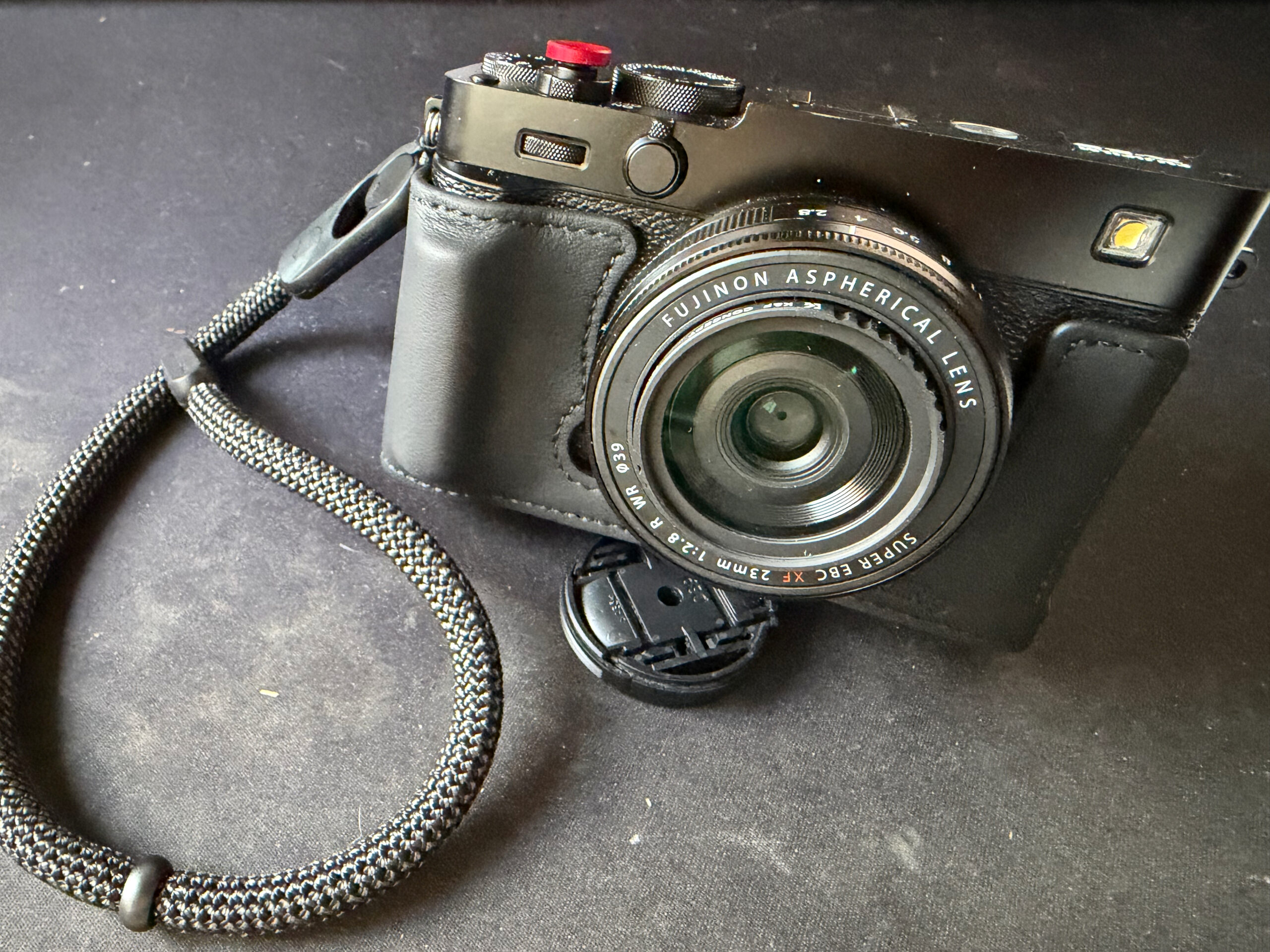

First walk out with the Fuji.