
Back in February, I mentioned a term called GAS: Gear Acquisition Syndrome and I’m desperately trying to avoid another bout of it, other than for the obvious reason that it works out rather expensive!
Some time ago, I think I said for one reason or another, I’d done complete camera system/manufacturer swaps three times over the years. The last one was to full frame and Nikon simply to get the photography finished for the book(s), certainly to an original image standard I was happy with. As it turned out, I probably didn’t need to bother, the size and quality of the printed images would have masked the problems with “noise” (grainy photos as opposed to smooth) in low-light situations that the Olympus E-M5 suffered, and I could see on screen. This only occurred when I needed push the ISO levels beyond where the 16MP sensor was happy (because indoor museum lighting is generally crap for photography!).
I have cursed myself for actually going through with the change numerous times since, primarily because the Olympus was lovely to use, I had a good set of lenses and the images it produced, certainly in adequate lighting, were brilliant. This switch over also roughly coincides with starting this website in 2022, hence if you trawl back far enough, you’ll see the merry-go-round with assorted cameras I’ve had since, and more recently with me moaning about camera/kit weights, poor ergonomics and add-on camera grips. Strangely though, two recent events have finally delivered the reasons behind my grumbling, much to my surprise.
A reviewer I was watching on a website complained about the Nikon Zf’s handling in much the same manner as I had, both with and without a grip, but he’d realised what the problem was: its purely the position of the shutter button, compared to the rest of the Nikon Z series (except the Z fc) and most other “modern” camera bodies. Just take a look at what was my Z5 in the header image, the shutter button is on top of the grip. On the Zf, it’s on the top plate, just like an old school 35mm camera. But as you need an add-on grip for the Zf with anything more than the pair of small prime lenses Nikon released, you end up twisting your hand/shutter finger maybe more than you’d like, and it just feels awkward.
I’ve used the Zf since I watched that review, and now it all makes sense, I’m happier, honest!….
My other gripe about weight of both full frame cameras and lenses, regardless of manufacturer, I understood would happen from day one, it’s basic optical physics. In the photo below, on the left is the APS-C sensor housed in my Fuji X-E5, on the right, the full-frame sensor of the Nikon Zf. The diameter and number of glass elements needed to focus light onto the sensor, which is also dependant on what task the lens is designed to do, add the auto-focus electronics, plus the lens barrel to house them all, makes most full-frame lenses moderately heavy, telephoto zooms and fast primes especially. The APS-C sensor and its associated lenses fare better simply because the sensor is smaller. By smaller, the full-frame sensor is 2.6 times larger than the APS-C, against the micro four-thirds (m4/3) sensor in my old Olympus it’s 4 times the size!
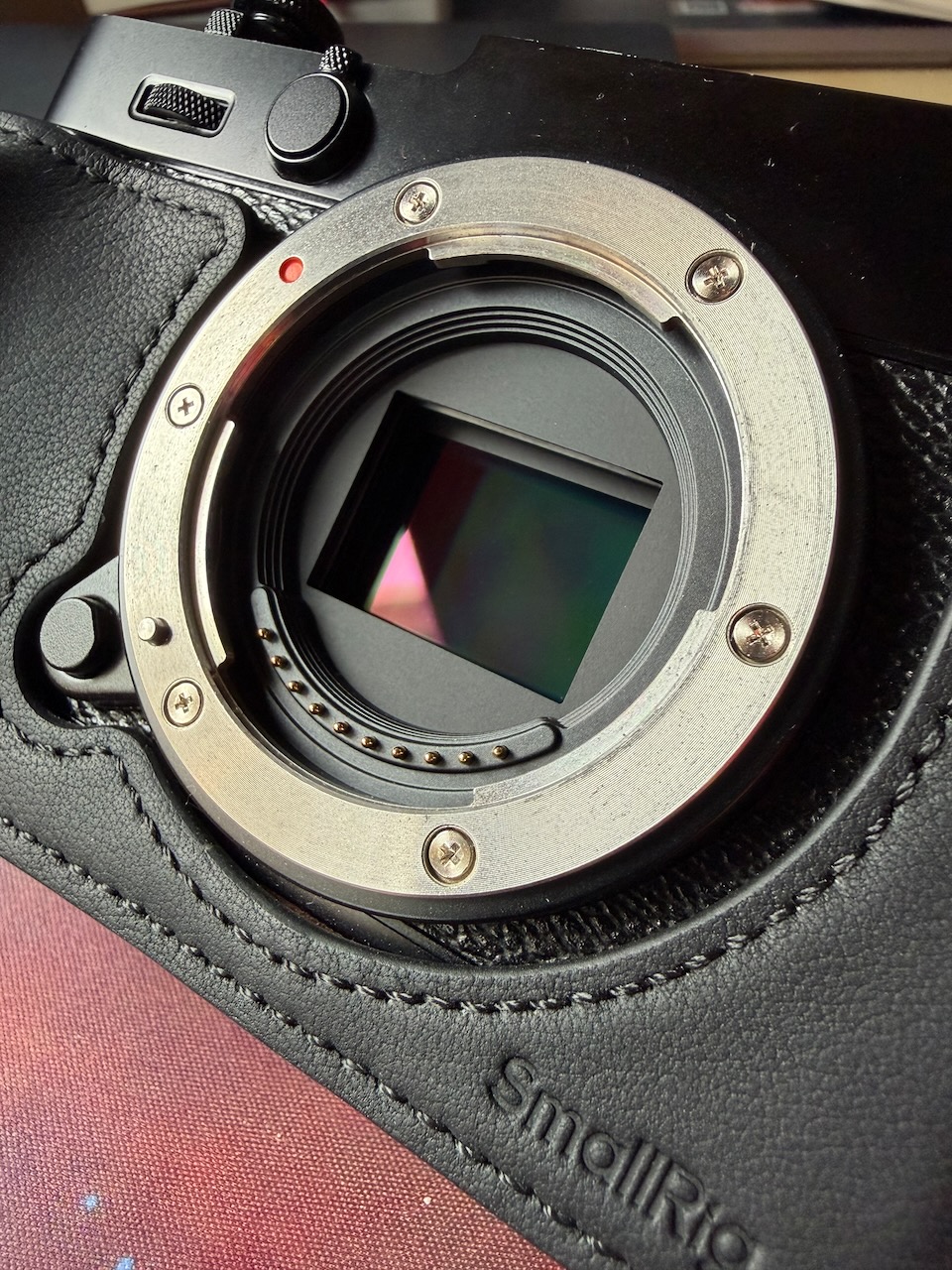
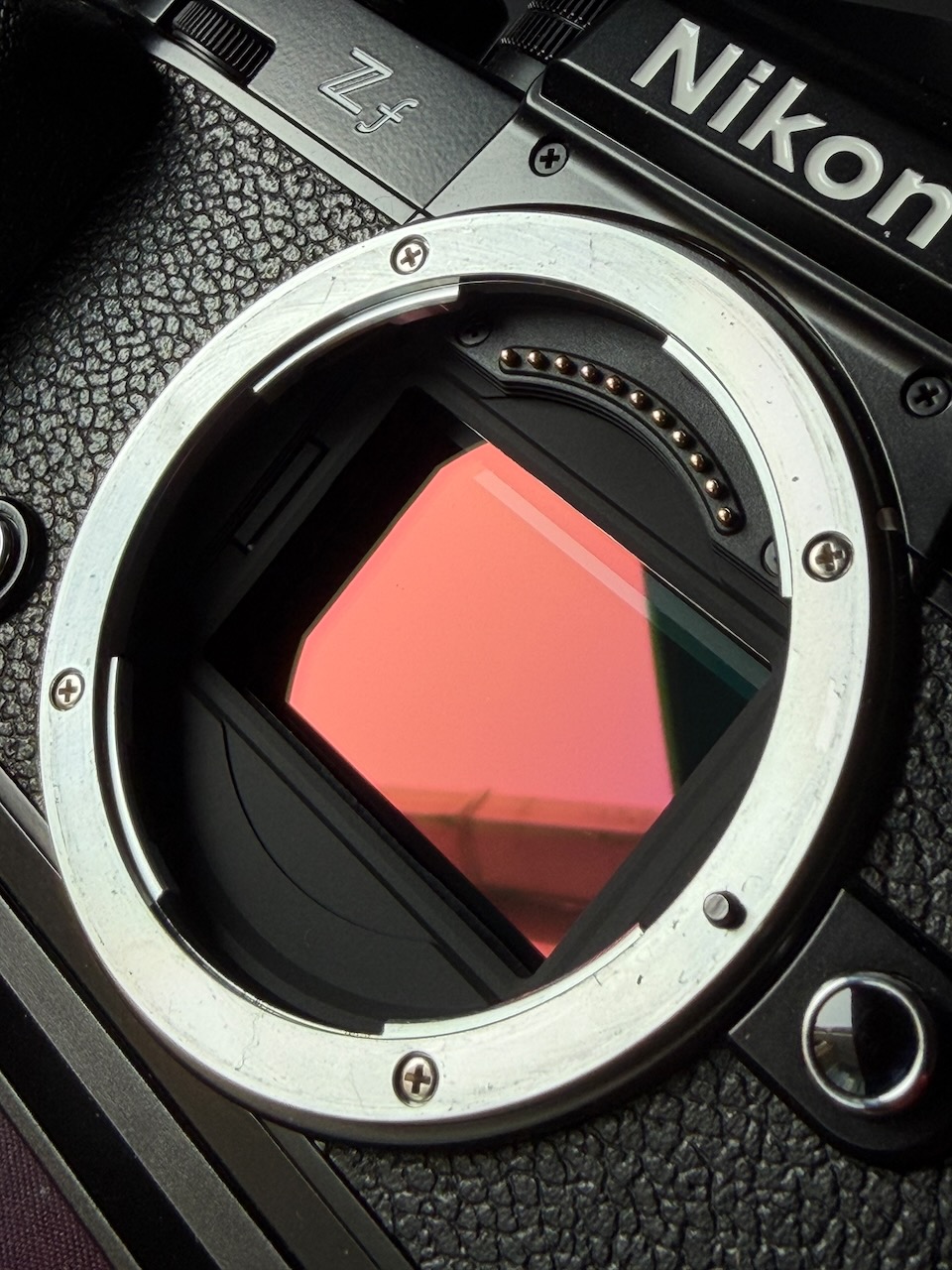
It’s this sensor size that governs the ability of full-frame to gather more light in low light situations than the smaller sensors. It’s also why issues could arise with pixel density causing noise on APS-C and other even smaller sensor cameras for an equivalent number of megapixels compared to full-frame, but that’s largely been solved. Hence the 40 megapixel Fuji sensor is heading for double that found in most of its APS-C competitors, let alone an awful lot of full-frame models.
Of course, if you really want good low light photography, you move to medium format like Fuji’s GF series, but that’s a whole different cost/weight scenario and I’m not going anywhere near, this side of a serious Lotto win and 180Kg baggage allowance on a, from Southampton, around the world cruise!
What really brought home why the weight thing was bugging me, happened in my favourite camera store, Harrisons. The used Fuji wide-angle zoom I’d bought online a couple of months ago was traded in against a used, smaller and lighter (yes, definitely a theme going on here!) Sigma lens, which balances better with the small body of the X-E5. I happened to mention I used Olympus E-M5 for ten years and the assistant handed me an ex-demo OM Systems OM-5 with the current equivalent lens attached to the one I used to use. Oh, dear!
Now I finally understood, four years or so down the line, why everything feels heavy…. because compared to an OM-5 II and 12-45 f2.8 pro lens, it is! I had completely forgotten just how light and small the micro four-thirds cameras are, which is one reason they’re popular with those who disappear into the wilderness, coupled with brilliant weather sealing and class optics. This is also why the OM series are still regularly recommended in the photography glossies and webpages.
Where this leaves me in terms of keeping the Nikon for “big jobs” or at least ones where really good low light capability is needed, or where I’m not worried about my camera gear taking half the weight of my cabin luggage, I really don’t know. There’s no doubting the output is excellent, and knowing what I gave up to move to full-frame in the first place, I’m very reluctant to part with it. I’ve got ideas (as ever…), but in the meantime, we’ll wait to see how well the Fuji performs on its travels first.